
Autism and Biting: How to Resolve Biting in Children with Autism

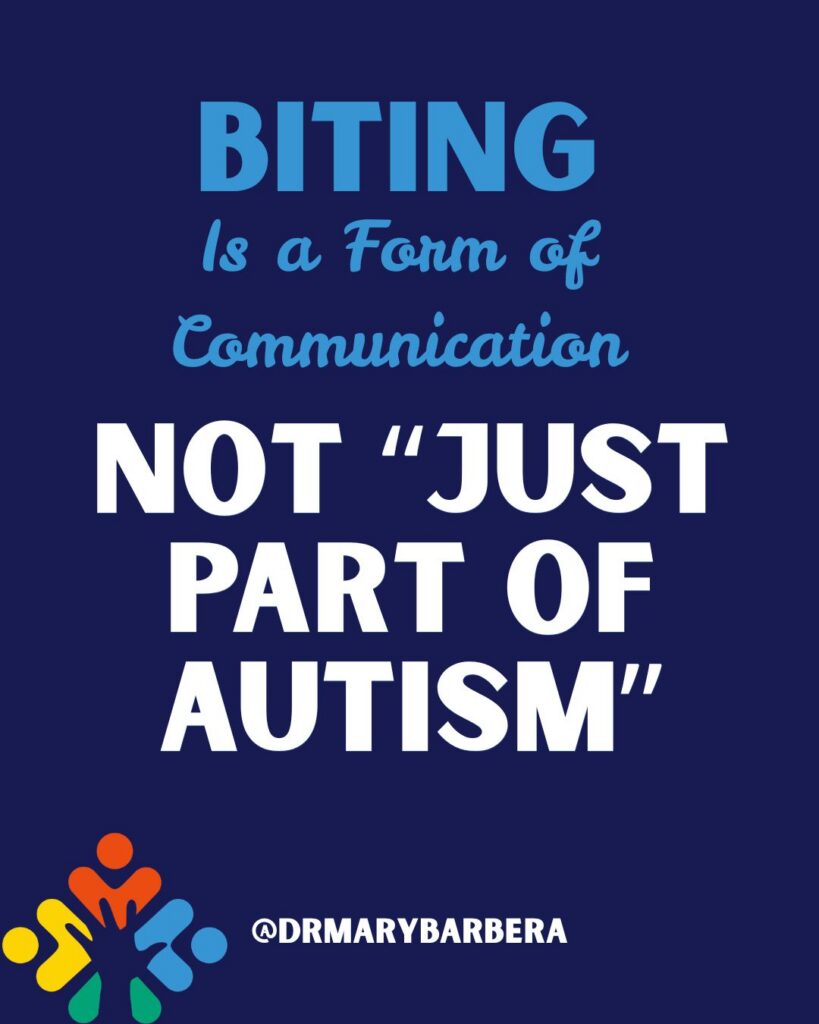
  • Biting is not “just part of autism”—it’s a behavior that needs to be addressed early. Autism and biting may frequently be seen together but that doesn’t mean we should not try to change the behavior. 
  • Most biting happens for a reason like communication struggles, pain, stress, or excitement. Looking into medical issues or possible pain is important. 
  • Prevention should be your main focus—what happens before the bite matters most. 
  • Simple tracking can show real progress and help you reduce biting in children with autism over time.
  • If you’re ready to take action with a step-by-step plan, you can join a free workshop by Dr. Mary Barbera here:
    👉 https://marybarbera.com/workshops

I frequently get asked about autism and biting. Is biting a sign of autism? Is it a part of autism? What can I do to help my child or clients stop biting? Each month within my private online communities, I provide a monthly Q and A call. And this month I tackled the important questions about biting and whether that’s a sign of autism or a part of autism.

If Your Child is Biting

As a registered nurse and a Board Certified Behavior Analyst, I think biting is one of the most serious problem behaviors that I can think of. Biting will get kids thrown out of preschool and daycare. It will get them into restrictive placements, like older kids who bite will sometimes not be able to continue on in public school. They’ll have to go to autism school where professionals wear bite guards. When I think of biting, it is just something that we have to tackle as early as possible.

Human bites are actually even more serious than animal bites because we have more bacteria in our mouth. If you get a bite as a professional or even as a parent or a sibling, it could lead to the need to see a doctor, get blood tests, potentially go on antibiotics, and you might need stitches. I’ve even seen biting where it caused ligament damage and nerve damage.
I don’t mean to scare you, but biting is very serious. And even parents who think that the child is just being playful and biting when they get excited versus aggressive bites, biting will still get you thrown out of really important places.

Autism and Biting

So biting should not be something dismissed as a part of autism. It’s not. Biting can be an indication that kids can’t communicate well, and we need to teach them to communicate. If children with autism also have Hepatitis B or AIDS, for instance, that can be even more dangerous. So we should tackle that quicker than most other behaviors that I can think of.
I did a really good podcast interview with Dr. Timothy Volmer. He’s an autism expert and researcher. And he specifically talked about biting as a response to pain and stress. He really helped me think about biting. So kids that bite, whether they bite themselves or bite others or bite objects, it could very much indicate that there is some pain or stress that they’re not able to communicate.
Dr. Volmer said that the research is clear that animals like birds and mammals bite themselves or bite objects when they are stressed and/or in pain. Also, if we think back about before anesthesia, think about the old cowboy movies where they bite on a towel during some surgical procedure or some painful event to try to relieve the pain.
I know for my son, Lucas, he bit people occasionally when he was young and then, when he got to be a teenager, he bit himself at points. And we could really tie that back to having allergy headaches, pain.
autism and biting. biting is communication

Assess the Whole Picture

So let’s talk about the four step turn autism around approach to tackle biting. Step one is assessment. And when we talk about assessment, we’re not diving in specifically right away to the biting. We’re looking at the whole picture. Age, ability level, communication level. Whether the child has allergies, is on medication, or if they have eating, sleeping, potty training problems. How they communicate.
Can they mand or request for what they want. Can they label things or answer questions? We also look at how they are socially. How are they with imitation, matching, following directions? And then we look at all their problem behaviors. And like I said, we want to really tackle biting as probably our number one problem behavior. But if they’re also gouging their eyes out or running in the street, we have to look at the whole picture and look at all the problem behaviors.

Then we finally look at biting. When it happens, why it happens. There’s probably a couple of functions. One is they’re in pain, we also need a medical assessment. Blood draws, ear checks, dental checks. A lot of our kids can’t tell us when they’re in pain.

Want to Learn how to Increase Talking & Decrease Tantrums in Children with Autism or Toddlers Showing Signs?

Want to start making a difference for your child or clients?
Make A Plan

So finally, we want to really focus in on when the biting happens and when it doesn’t happen. Then step two is making a plan. We want to prioritize the most serious problem behaviors. But we don’t want to forget about the whole picture because we need to spend 95% of our time preventing biting. For instance, we think that happy bites occur when the child gets overly excited, like where they want to wrestle. Or when I carry my toddler like a baby, he sometimes bites my shoulder. Or if you’re still breastfeeding, he bites during breastfeeding.
I breastfed my typically developing son, Spencer, really late. Past two years of age. And when he would bite, I was told to take him off, put him down, say no, and wait at least 30 seconds before resuming. And that worked. So if you’re carrying a toddler and they’re biting you on the shoulder, put them down. Say no, wait at least 30 seconds. And you may want to stop carrying them like that.
And if it’s wrestling or something like that, I would stop completely. Think of other fun things like spinning a child in an office chair or rocking them or bouncing them on a ball. You can still do fun things, but if wrestling has been chained with biting, then we need to stop that.
Part of planning is thinking what do I need to stop or change? I think a lot of parents are trying their best to be kind and gentle. And I’m a very child-friendly approach kind of person. But with biting, you do need to have the child realize that that’s a no. And you don’t have to necessarily say no biting. You could. But when the incident is over and the 30 seconds has passed, we’re not talking about biting.
We’re not telling my husband or my neighbor about the biting. We’re not saying, “oh, Johnny, you can’t be biting mommy that’s bad.” No, it’s no biting or no firmly and then 30 seconds or a minute passes, then the slate is clear.
And if we’re talking about biting after that, we are spelling it. Because nine times out of 10, if you are talking about biting, the child knows “I can get mommy’s attention, I can get out of things, I can get things.”

How to Prevent Biting

Teaching is the third step of the Turn Autism Around Approach. We’re going to spend 95% of our time on prevention. We’re going to stop the things that lead to biting such as wrestling. But if you want to continue to breastfeed, that’s fine. We just need to have an interruption and no, and then wait a little bit and then resume. Put your child down. Don’t say, “no biting mommy” or “ouch that hurts.” You’re still holding them. And that doesn’t sound like no. It doesn’t sound like there’s a problem. Say “No biting,” put them down and then pick them up. That is an interruption. It’s a consequence.

Take Data of the Biting

And the fourth step of the Turn Autism Around Approach, which is super important, is taking data. We still track Lucas’s self-biting. We have a physical calendar. I talk about this in my book and on a video blog.
We have a red pen and we have a pencil. The pencil is for scheduling. The red pen in the is for keeping track of any self-injurious behavior, any aggressive behaviors. Anything like that goes in the calendar.
Every allergy shot is tracked, any kind of antibiotics supplements. He has some motor tics sometimes that are tracked in red. And then I use this to help the doctor adjust any medication and those sorts of things. So I would highly suggest you keep a calendar.

Also, ABC data is important if you don’t know the function and if these behaviors don’t go away very quickly. The calendar can help you track if the biting is increasing or decreasing over time. If you would like to be a part of my community or learn more about autism and biting, you can always attend a free online workshop at marybarbera.com/workshops.

Autism and Biting Top 5 FAQ

Biting by itself is not a sign of autism, but it can be more common in children with autism or developmental delays—especially when communication skills are limited. Many young children (with or without autism) go through phases of biting. The key is to look at the whole picture, including language, social skills, and other behaviors, rather than focusing on biting alone.


If you’re unsure whether your child’s behaviors could be early signs, you can start by reviewing developmental milestones and getting a clearer picture with a free assessment like the BECA here:
👉 https://marybarbera.com/assessment

Children may bite for several different reasons, including:

  • Difficulty communicating wants or needs
  • Pain or discomfort (like ear infections, headaches, or dental issues)
  • Sensory input or stress relief
  • Excitement during play or interaction

Biting is often a form of communication. When a child doesn’t have an easier or more effective way to express themselves, biting can take its place.

If you want to learn how to increase communication and reduce problem behaviors like biting, you can read Chapter 1 of Turn Autism Around and access free resources here:
👉 https://marybarbera.com/new-book

Sometimes biting can be a short-lived phase—but waiting it out is risky.
If biting is ignored, it can:

  • Become more frequent
  • Lead to injuries or infections
  • Result in a child being removed from daycare, school, or activities

It’s always better to address biting early rather than hope it goes away on its own.

If you’re ready to take action with a step-by-step plan, you can join a free workshop here:
👉 https://marybarbera.com/workshops

In the moment, keep your response:

  • Calm and brief (avoid long explanations)
  • Clear and consistent (a simple “no” and short pause is enough)

More importantly, focus on what happens before and after:

  • Prevent situations where biting is likely
  • Teach safer ways to communicate (like pointing, signing, or using words)
  • Adjust routines if certain activities (like rough play) trigger biting

If you want to learn about preventing and reducing problem behaviors like biting and increasing talking and other self care skills. Start with a free workshop

Prevention is the most important step. You can:

  • Identify triggers (when and where biting happens)
  • Reduce or modify high-risk situations
  • Offer safer alternatives (like movement activities instead of rough play)
  • Increase communication opportunities throughout the day

Tracking bites on a simple calendar can also help you see patterns and measure progress over time.

Learning more about skills a child needs to learn through the 10 minute BECA assessment, can help prevent biting. 

I frequently get asked about biting and autism: Is it a sign of autism? Is it a part of autism? What can I do to help my child or clients stop biting? Today, I’m answering that question for you. Hi, I’m Dr. Mary Barbera—autism mom, Board Certified Behavior Analyst, and bestselling author. Each week, I share ideas about turning autism or signs of autism around. If you haven’t subscribed to my YouTube channel yet, you can do that now. Each month within my private online communities, I host a live Q&A call. This month, I tackled the important question of biting, and I thought I’d replay it here. As a registered nurse and a BCBA, I consider biting one of the most serious problem behaviors. Biting can get children thrown out of preschool and daycare. Older kids who bite may end up in restrictive placements, even autism schools where professionals wear bite guards. Human bites are actually more serious than animal bites because our mouths carry more bacteria. Bites can require medical care, blood tests, antibiotics, or even stitches. Some cases lead to ligament or nerve damage. Even if parents think their child is “playfully” biting when excited, it’s still very serious. Whether it’s happy bites or aggressive bites, biting can get a child excluded from school, programs, or community activities. Biting should never be dismissed as “just part of autism.” Often, biting indicates a child cannot communicate well. We need to teach them other ways to express themselves and prevent biting from occurring. Biting also poses extra danger if the person biting has health conditions like hepatitis B or HIV. Understanding Why Biting Happens Biting can occur for many reasons. Sometimes it’s pain or stress. Dr. Timothy Vollmer, an autism researcher I interviewed, explained that both animals and humans bite themselves or objects when stressed or in pain. Historically, before anesthesia, people would bite down on a towel during surgery or other painful events as a coping mechanism. In my own experience, my son Lucas bit people occasionally when he was young. Later, as a teenager, he bit himself. We traced those episodes to pain—specifically, allergy-related headaches. Biting was his way of expressing discomfort. Other times, biting can look more playful. Like puppies, some children bite when overly excited—during wrestling, roughhousing, or even while breastfeeding. Regardless of whether it’s playful or aggressive, biting must be addressed. The Turn Autism Around 4-Step Approach Step 1: Assessment Don’t jump straight to biting alone. Look at the whole picture: the child’s age, developmental level, communication skills, allergies, medications, sleep, eating, and potty training. Can they request their needs? Can they follow directions? How are their social and imitation skills? Then, focus on problem behaviors, with biting at the top of the list. But also check for medical issues: ear infections, dental pain, headaches, or other sources of discomfort. Many children with autism can’t easily tell us when they’re in pain, so medical evaluations are crucial. Step 2: Planning Once you’ve gathered information, make a plan. Prioritize serious behaviors like biting. Prevention should take up 95% of your effort. For playful bites—like shoulder biting when being carried or biting during wrestling—change routines. Stop carrying the child in a way that encourages biting, or avoid wrestling if it has become linked with biting. When my son Spencer bit during late breastfeeding, the advice I got worked: stop, say “no,” wait 30 seconds, then resume. That interruption was enough to teach him biting wasn’t acceptable. Similarly, if a child bites during play, end the play briefly before resuming. Step 3: Teaching & Prevention Focus on preventing situations where biting occurs. Replace rough play with safe alternatives: spinning in a chair, bouncing on a ball, or rocking. Use clear, firm interruptions when biting happens—“no” and a short pause. Avoid overexplaining (“ouchie, that hurts”) because children with delays may not understand and may even find the attention reinforcing. Step 4: Tracking & Data Tracking behavior is essential. With Lucas, we used a physical calendar. Red ink marked self-injury, agitation, medications, doctor visits, or allergy shots. That log helped doctors adjust treatment and helped us monitor progress. You can also track bites per day. For example, moving from 10 bites a day to 1 bite a week shows progress. If biting persists, take ABC data (antecedent, behavior, consequence) to understand triggers and functions. Biting is a very serious problem behavior, more urgent than many others. Whether caused by pain, stress, or overexcitement, it must be addressed quickly and systematically. Use assessment, planning, prevention, and tracking to reduce biting. I hope you found this helpful excerpt from my community valuable. If you’d like to join us, you can attend a free online workshop at marybarbera.com/workshops. If you liked this video, please share it, give it a thumbs up, leave a comment, and I’ll see you next week on another episode of Turn Autism Around.

Want to Learn how to Increase Talking & Decrease Tantrums in Children with Autism or Toddlers Showing Signs?

Want to start making a difference for your child or clients?

About the Author

Dr. Mary Barbera, RN, BCBA-D is a best-selling author, award-winning speaker, and Board Certified Behavior Analyst with a Ph.D. in leadership. As both an autism mom and professional, Mary brings over 25 years of experience helping thousands of parents and professionals around the world. She is the creator of the Turn Autism Around® approach and author of The Verbal Behavior Approach and Turn Autism Around: An Action Guide for Parents of Young Children with Early Signs of Autism. Through her books, online courses, and podcast, Mary empowers families to increase talking, reduce tantrums, and improve life skills in young children with autism or signs of autism.